Research Overview
We investigate how emotions guide social cognition and behavior. Rather than viewing emotions as irrational noise, our lab asks how emotions provide vital signals for decision-making, translating information from the social environment into choices.
Building on computational frameworks, our research explores how emotion actively constructs the processes underlying human decision-making, with a special focus on social dynamics.
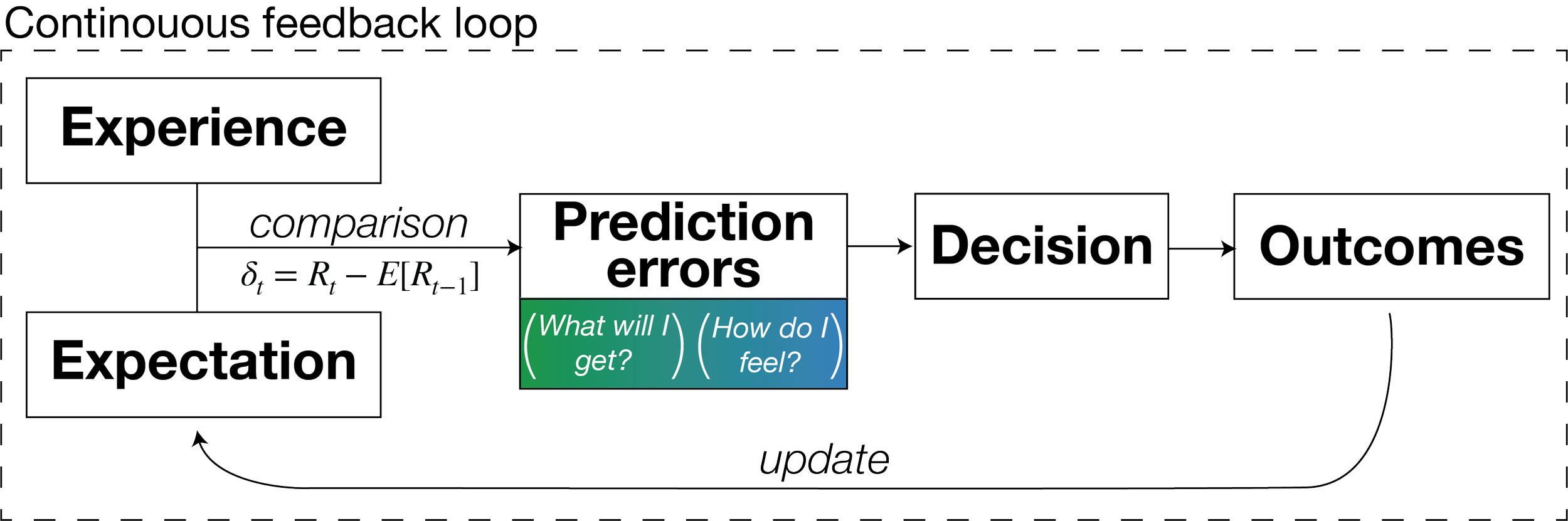
Affective Prediction Errors and Cognition
How does the gap between how we expect to feel and how we actually feel shape our choices? We explore how these affective prediction errors drive learning, cognition, and everyday decision-making, including the separable neural mechanisms tracking emotion and reward as distinct computational signals, evaluated on different timescales. These same signals shape real-world behavior and we use smartphone platforms to understand how these signals guide which activities people turn to after an emotional surprise.
Emotion and Interpersonal Decision-Making
How do emotions inform our social behaviors, especially during competitive social interactions? We use a computationally-grounded framework to understand the precise mechanisms that allow emotions to guide how we interact with others, and how moral norms constrain that flexibility. For example, when someone is treated unfairly, we study how the resulting emotion alters the threshold between choosing to punish or forgive and more broadly, how emotionally framed messages can nudge people toward cooperative choices.
Language, AI, and Social Dynamics
How does the language we use shape our emotions and behavior? We study emotional language in real-time social interactions to see how linguistic patterns predict mental health outcomes and behaviors. As technology evolves, we’re also exploring how natural language conversations with AI shape emotional dynamics and social behavior.